What "a fast website" actually means
Speed isn't a feeling, it's three measurements you can run yourself in about thirty seconds. Here's what they are and what a good score is worth to a business.
Updated
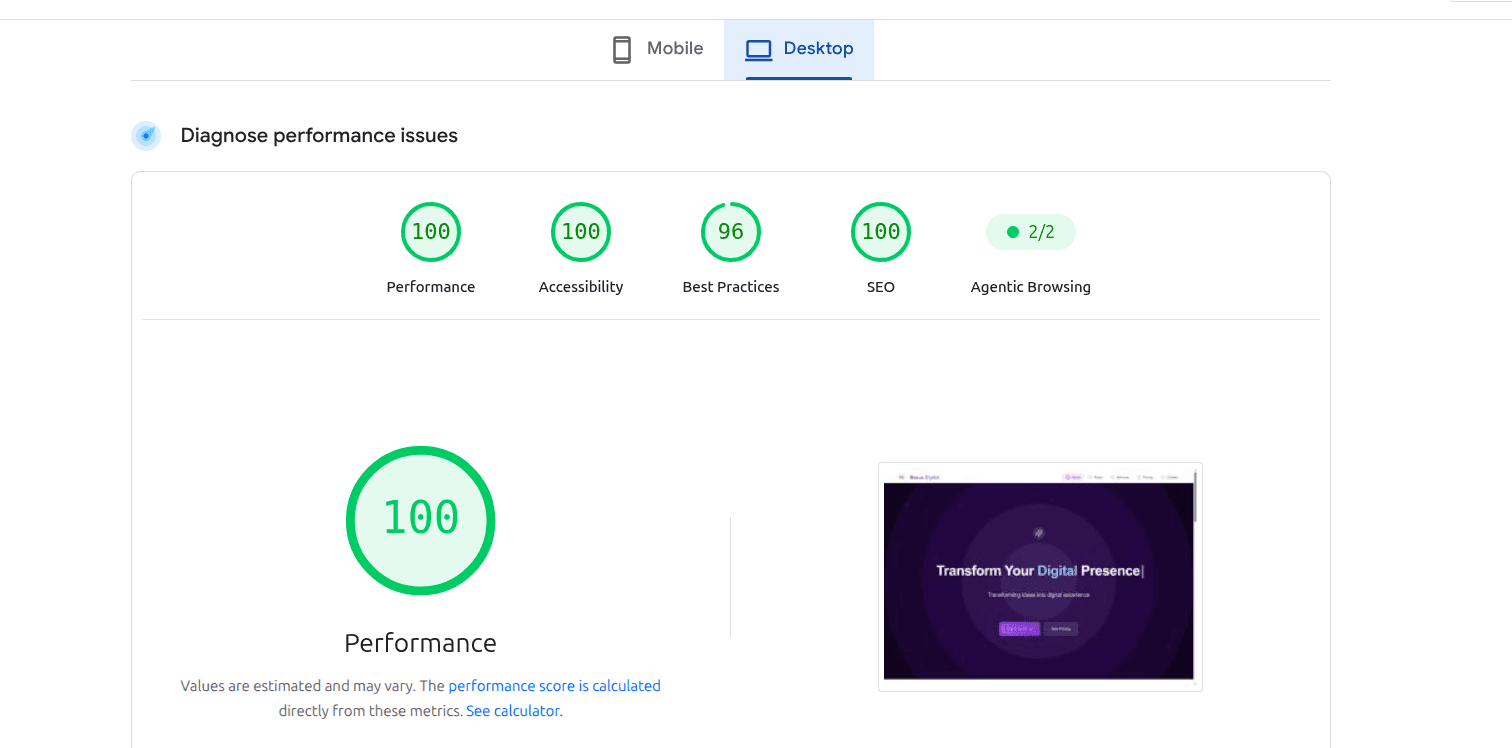
"Fast" gets used as if it were a matter of taste. It isn't. Google publishes three specific measurements, they're free to run against any URL, and they're the same numbers that feed into search ranking.
Here's what they mean in plain terms.
The three numbers
Largest Contentful Paint (LCP) — how long until the main thing on the screen appears. Usually the headline or hero image.
Good score: Under 2.5 seconds.
This is the one people actually experience as "slow": the stretch where you're looking at a blank or half-drawn page wondering whether to leave.
Interaction to Next Paint (INP) — when you tap something, how long until the page visibly responds.
Good score: Under 200 milliseconds.
Poor INP is the sensation of tapping a button twice because you weren't sure the first one registered.
Cumulative Layout Shift (CLS) — how much the page jumps around while loading.
Good score: Under 0.1.
This is the one that makes you tap the wrong thing because an ad or an image loaded above where you were reading and shoved everything down.
Notice that all three describe an experience, not a technical property. That's deliberate on Google's part, and it's why they're worth caring about even setting search rankings aside.
How to test your own site, free
Open PageSpeed Insights:
Paste in any URL and wait about thirty seconds. It'll give you a score out of 100 for:
- Performance
- Accessibility
- Best Practices
- SEO
Two things are worth knowing when you read the result:
- Check the Mobile tab, not just Desktop. Most visitors are on a phone, often on an average connection, and mobile scores are usually meaningfully lower.
- A single test has some variance. Run it twice before drawing conclusions from a small difference.
What a good score is actually worth
Two things, one direct and one indirect.
The direct one is that people leave slow sites. Google's own research puts the bounce probability up substantially as load time climbs past three seconds. If you're paying for traffic, a slow site means you're paying for visits that leave before seeing anything.
The indirect one is ranking.
Core Web Vitals are a confirmed ranking signal. They're not the biggest one—relevant content still matters far more—but they're a tiebreaker, and tiebreakers decide a lot of search results.
Why most sites are slow
Rarely one dramatic mistake. Usually an accumulation:
- Images uploaded at full camera resolution and scaled down in the browser, so a 4 MB photo downloads to display at 400 pixels wide.
- A stack of third-party scripts—chat widgets, analytics, tracking pixels, A/B testing tools—each of which seemed small on its own.
- A page template that loads everything for every page, whether the page needs it or not.
- Fonts that block rendering, so text stays invisible until they've downloaded.
None of these are exotic. They're the default outcome of building without a performance budget, which is why the fix is mostly discipline rather than cleverness.
Our standard
Every site we ship scores 95 or above.
We treat it as a defect if it doesn't, and defects are fixed free within the warranty period.
We publish that number because it's checkable. You can run the test on this page right now, and on any site in our portfolio, and see whether the claim holds.
That's the only kind of quality claim worth making—one where you don't have to take our word for it.
- Performance
- SEO